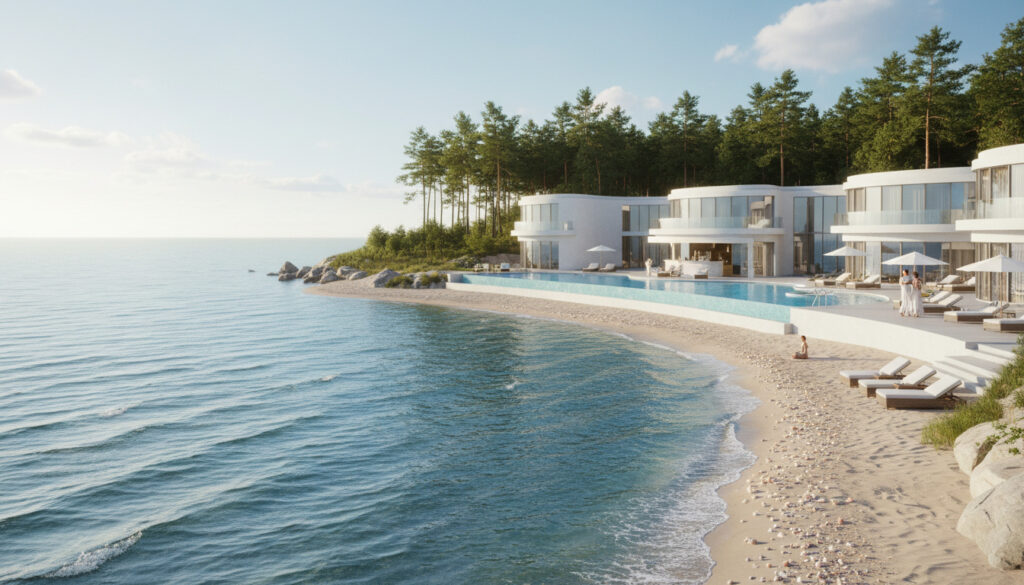
Estonia Resort Hotel & Spa – Rentouttava Loma Meren Rannalla
Estonia’s Therapeutic Coastlines
Estonia’s resort hotels and spas merge Nordic design sensibilities with centuries-old bathing traditions. Along the Baltic coast and nestled within lake districts, these destinations leverage mineral-rich groundwater and pristine forest settings to offer medical-grade wellness treatments. Estonian tourism authorities note that the sector has evolved distinctly from its Soviet sanatorium roots into sophisticated facilities attracting visitors from across Northern Europe.
Leading Destinations
The country’s spa landscape centers on Pärnu, Estonia’s summer capital, though notable properties extend to Saaremaa Island and the Otepää highlands. Hedon Spa & Hotel anchors the Pärnu riverfront with infinity pools and contemporary architecture, while mainland properties compete on therapeutic specialization.
- Estonia Resort Hotel & Spa – A beachfront property specializing in thalassotherapy and Nordic mineral treatments.
- Tervise Paradiis – A family-oriented water park and spa hybrid catering to multigenerational travelers.
- Pühajärve Spa & Holiday Resort – Located in southern Estonia’s lake district, offering forest views and traditional smoke sauna rituals.
- Viiking Spa Hotel – Situated on Saaremaa Island, combining mud therapy traditions with modern wellness facilities.
Market Evolution
Contemporary Estonian spa hotels distinguish themselves through medical supervision. Unlike purely recreational wellness centers, properties such as Estonia Resort Hotel & Spa employ physiotherapists and balneologists who prescribe specific treatment courses. This clinical approach traces to Estonia’s history of sanatorium-based healthcare, now repackaged within four-star hospitality standards. Baltic spa tourism increasingly competes with Finnish and Swedish destinations on price without compromising treatment quality.
Comparative Overview
| Property | Primary Therapy | Pool Facilities | Seasonal Peak |
|---|---|---|---|
| Hedon Spa | Seawater treatments | Infinity pool, children’s pool | June–August |
| Estonia Resort | Thalassotherapy | Thermal pool complex | May–September |
| Tervise Paradiis | Family wellness | Water park, therapy pools | Year-round |
| Viiking Spa | Mud therapy | Mineral baths | July–August |
Facilities like Tervise Paradiis distinguish themselves through integrated water parks alongside medical pools, capturing family segments while maintaining therapeutic credibility.
Treatment Specifics
Standard packages typically include 10-15 sessions over five to seven days. Physiotherapy, massage, and mineral baths form the core offerings, with many hotels providing specialized programs for circulatory or respiratory conditions. Pühajärve Spa & Holiday Resort emphasizes smoke sauna rituals combined with lake-water immersion cycles, documented in Estonian wellness traditions as essential cardiovascular treatments.
Accommodation ranges from standard doubles to apartment-style suites with kitchenettes for extended stays. Dining options emphasize local ingredients—smoked fish, rye bread, forest berries—prepared with dietary considerations for spa guests.
Historical Context
Estonia’s spa culture dates to the 19th century when Baltic German nobility established bathing resorts in Pärnu. The interwar period saw modest development until the Soviet era transformed these facilities into medical institutions serving workers’ unions. Viiking Spa Hotel exemplifies the transition, having converted Soviet-era infrastructure into modern wellness complexes while preserving therapeutic mud sources.
Post-independence restoration beginning in the 1990s introduced Western hospitality standards. EU accession in 2004 accelerated quality improvements, with properties renovating to meet international spa certification requirements.
Practical Considerations
Language presents minimal barriers. Front-desk and medical staff typically communicate in Estonian, Russian, and English, with Finnish widely understood near the northern coast. Treatment bookings require advance scheduling, particularly for specialty therapies.
Thermal facilities maintain strict gender-segregated sauna traditions alongside mixed-gender pools. Visitors should note that medical treatments require brief consultations, though these rarely exceed 15 minutes. Most hotels offer day-spa access for non-residents, though accommodation packages provide better value for multi-day therapy courses.
Regional Positioning
Estonian spa hotels occupy a distinct market niche between Finnish luxury pricing and Latvian budget options. The country’s compact geography allows multi-destination itineraries—visitors often combine Pärnu beach therapy with Tallinn city breaks or Saaremaa nature retreats within a single week.
Water quality regulations exceed EU minimums, with regular testing of mineral springs and mud deposits. This regulatory environment supports insurance reimbursement for certain medical treatments, particularly for EU citizens with appropriate documentation.
Visitor Perspectives
The mineral pool maintained exactly 32 degrees—perfect for my circulation issues. The medical staff spoke fluent Finnish and adjusted my program daily based on blood pressure readings.
— Regular visitor from Helsinki
We combined mud treatments with cycling around Saaremaa. The contrast between therapeutic stillness and active exploration defined the experience.
— Travel journal excerpt
Summary
Estonia’s resort hotels deliver medically supervised wellness within accessible hospitality frameworks. The combination of mineral water resources, competitive pricing, and Nordic service standards creates viable alternatives to Southern European thermal destinations. For travelers seeking therapeutic outcomes alongside leisure, the country’s spa infrastructure offers legitimate medical value without institutional austerity.
Common Questions
Do Estonian spa hotels require medical referrals?
No referrals are needed for standard wellness packages. However, specific medical treatments—such as physiotherapy or balneology—may require preliminary consultation with on-site doctors. EU citizens can sometimes receive reimbursements with valid European Health Insurance Cards, though prior arrangement with home-country insurers remains essential.
What languages are spoken at Estonia Resort properties?
Estonian and Russian serve as primary languages, with English and Finnish widely spoken at front desks and in medical departments. Pärnu-based hotels specifically cater to Finnish tourists, often employing native speakers in therapeutic roles.
Are the treatments covered by travel insurance?
Standard travel insurance rarely covers elective spa treatments. However, prescribed medical procedures—such as supervised physiotherapy following injury—may qualify for reimbursement depending on policy terms. Estonian spa hotels provide detailed invoices suitable for insurance submission.
Which season offers optimal value?
September through November and March through May provide lower accommodation rates while maintaining full treatment availability. Winter months offer unique snow sauna and ice swimming experiences, though shorter daylight hours limit outdoor activities.
How do Estonian spas differ from Finnish saunas?
While Finland emphasizes dry heat sauna culture, Estonian resort hotels focus on water-based therapies—mineral baths, mud treatments, and therapeutic swimming pools. Estonian facilities typically offer more extensive medical supervision and longer treatment courses than standard Finnish spa hotels.
Lisaa liittyvia artikkeleita
 Suomi-englanti kääntäjä ilmainen – DeepL paras vertailussa 2025
 Mikä on serif-fontti? Selitys ja esimerkit
 Mistä johtuu korkea alapaine? – Syyt, viitearvot ja hoito
 Posti S-koon Paketti Tarjous – Nouto S-marketista ja Ehdot
 Tori-fi: Opas myyntiin, vuokraukseen ja hakuun 2025
 Olga Temosen elokuvat ja tv-ohjelmat – katsaus uraan
 Musta tee kofeiini: paljonko mg kupissa? Vertailu
 Marko Keränen Syöpä – Vahvistetut Faktat Isän Sairaudesta
